
Shop for Music
About the Composer

Timothy C. Takach
Timothy C. Takach Publications
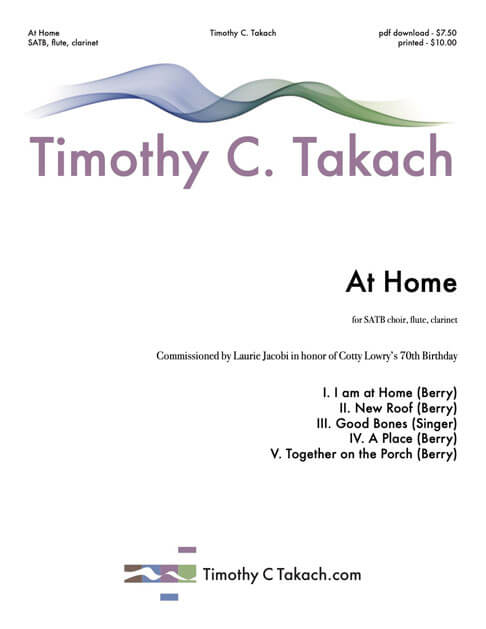
At Home
Five beautiful stories about the place we call home and the people with whom we share it.
SATB, flute, clarinet
“At Home” is a stunning piece about where we belong. Using four poems from Wendell Berry and one from Julia Klatt Singer, it beautifully sets the story of a couple and their definitions of home: being together, being alone, and their physical dwelling. Unashamedly melodic, Takach has crafted intuitive vocal lines that feel wonderful to sing and hear. The obbligato flute and clarinet parts play the roles of the couple, intertwining with each other and commenting on the stories. Movement IV is a round, and ends with the instrumentalists at the back of the hall to finish the cycle. “At Home” is a wonderfully honest work and can serve as a centerpiece of a program.
Composer’s Notes
Writing a piece about home is not a terribly unique venture, but it is one that is so rich and has inspired many poets and composers. This is no surprise, for everyone remembers and celebrates the place where they belong. To me, At Home strays from some of the normal tropes of youth, ancestry, and birth home memories and instead moves toward the home we create as adults. Since the piece was commissioned by Laurie Jacobi for her husband Cotty Lowry’s 70th birthday, the poetry I chose feels very personal, very specific. From the first movement we know the characters: there is a “you” and “I,” the two people occupying this place. But Wendell Berry’s poem doesn’t immediately join these two people together, he instead asserts his own individuality of where he finds himself at home, and it’s alone, out in nature. Yet he still cares for his partner in this poem, wishing for them to stay just as content in their own personal place of belonging.
Cotty Lowry is a realtor, and so Laurie wanted to include moments that described the physicality of houses. The maintenance, the aging, the sense of space. “New Roof” does this so well, combining Berry’s love of nature with the grounding element of his house. The rising arpeggios in the winds are constantly searching upwards, let loose from the confines of the house to reach the boundless. “Good Bones” is a commissioned poem from longtime collaborator Julia Klatt Singer, whose language and imagery matches Berry’s so well. This ode to an aging house is a delightful metaphor for our own bodies: how they age and how they are loaded up with wisdom, experience and memories. Her flirtatious way of recalling the couple’s history is mirrored in the clarinet writing and the harmonies from the choir. (See if you can spot the musical quote, played by the piano in the hallway.)
“A Place” is full of movement, with the choir singing in a round, and the woodwinds moving from the front of the hall to the back. It’s here that Berry tells us that the journey we’ve been on our whole life has not been a journey at all, but the place we’ve been seeking. So we find our couple finally at home, “Together on the Porch.” After embracing their individuality in the opening movement, they now occupy the same space, in a quiet routine of love and of life. They know they are loved, but they choose to say the words out loud anyway. And not knowing which will be the first to go back into the house is the same as not knowing who will outlive the other. There is no fear, but they find comfort and fulfillment instead in the present time and present place. Not the journey, the place. At home.
– Timothy C. Takach, 2019
Program Notes, by Joshua Shank:
At Home is a 2019 work by Minnesota-based composer Timothy Takach which draws on four texts by famed Kentucky poet Wendell Berry, supplemented by another from fellow Minnesotan Julia Klatt Singer. It was commissioned by a woman to celebrate the 70th birthday of her husband, an affable local realtor in the Twin Cities.
Inspired by his profession, At Home celebrates the dwellings we endeavor to make our own in order to shape a life within them. Across five movements, the work explores the physical and emotional life of a home, tracing a journey from individuality to companionship, and showing how these places are built not just from walls and roofs, but from care, attention, and the shared rhythms of life together.
The first two movements are brief. “I am at Home” features a near-constant accompaniment of flute and clarinet, a conspicuous duo perhaps inspired by the husband and wife behind the creation of the work. Then, in “New Roof,” Berry adds a piece of himself to his home through the unglamorous—but in his hands deeply meaningful—work of replacing a roof. Throughout, Takach has the choir simply deliver the text, as if they’re reading it to the listener. The music is unpretentious and quietly reflective, mirroring the simplicity and honesty of the great American poet who wrote the words.
“Good Bones” borrows a real-estate phrase: A house may age, but if it has “good bones,” it’s still got charm. The poem extends this notion to life and love, celebrating the quiet familiarity of a couple growing old together. Takach sets the words with cheeky swung rhythms and warm choral harmonies, capturing the poem’s humor and affection, showing how a home and a partnership carry the marks—and joys—of a life well lived. Then, in “A Place,” Takach sets the text in a flowing round, with Copland-esque harmonies suggesting open skies leading to a quiet arrival. The choir weaves overlapping lines while woodwinds move through the hall, celebrating another aspect of “home:” coming back to it.
At Home is brought to a gentle close in “Together on the Porch,” which finds a couple at home in a quiet routine and shared understanding (which eventually serves as a subtle metaphor for something else). The full choir sings, but on the page, the music is written in only two parts throughout: a nod to the two subjects in Berry’s tender poem. Takach departs from this voicing only once—on the word “goodnight”—and in the final measures, the sun sets on the home and the lone partner who remains.
Text
Texts:
I. I am at Home
I will wait here in the fields
to see how well the rain
brings on the grass.
In the labor of the fields
longer than a man’s life
I am at home. Don’t come with me.
You stay home too.
I will be standing in the woods
where the old trees
move only with the wind
and then with gravity.
In the stillness of the trees
I am at home. Don’t come with me.
You stay home too.
– Wendell Berry (Copyright © 2012 by Wendell Berry, from New Collected Poems. Reprinted by permission of Counterpoint Press.)
II. New Roof
On the housetop, the floor of the boundless
where birds and storms fly and disappear,
and the valley opened over our heads, a leap
of clarity between the hills, we bent five days
in the sun, tearing free the old roof, nailing on
the new, letting the sun touch for once
in fifty years the dusky rafters, and then
securing the house again in its shelter and shade.
Thus like a little ledge a piece of my history
has come between me and the sky.
– Wendell Berry (Copyright © 2012 by Wendell Berry, from New Collected Poems. Reprinted by permission of Counterpoint Press.)
III. Good Bones
From the road, all tucked-in and tidy
Between the hydrangeas
and the twilight sky.
You’ve always like the old ones best
For their charm, their good bones.
Gravity has a way of dropping
Everything under the dresser
Into the corner
Can’t lose your marbles
If you know
(More or less) where they’ve gone.
Remember the first place we lived?
How there was room for the piano
If we left it in the hallway?
Remember the winter nights?
How we laid awake waiting
For the pipes to burst?
We turn up the lights (the bulb’s burned out)
Add another coat of paint.
How many times have you tapped this nail
Back into place?
Each wall tells a story.
Each floor sings the mockingbird’s song.
Light the candles, dim the lights,
we’ll change the bulb another day.
You are wise, appreciate
what was once straight
now softly curves.
Still standing.
Good bones.
– Julia Klatt Singer (Commissioned poem. Used with permission.)
IV. A Place
There is a day
when the road neither
comes nor goes, and the way
is not a way but a place.
– Wendell Berry (Copyright © 1998 by Wendell Berry, from A Timbered Choir. Reprinted by permission of Counterpoint Press.)
V. Together on the Porch
They sit together on the porch, the dark
Almost fallen, the house behind them dark.
Their supper done with, they have washed and dried
The dishes–only two plates now, two glasses,
Two knives, two forks, two spoons–small work for two.
She sits with her hands folded in her lap,
At rest. He smokes his pipe. They do not speak.
And when they speak at last it is to say
What each one knows the other knows. They have
One mind between them, now, finally
For all its knowing will not exactly know
Which one goes first through the dark doorway, bidding
Goodnight, and which sits on a while alone.
– Wendell Berry (Copyright © 1998 by Wendell Berry, from A Timbered Choir. Reprinted by permission of Counterpoint Press.)
$7.50 per licensed PDF




Reviews
There are no reviews yet.