
Shop for Music
About the Composer

Timothy C. Takach
Timothy C. Takach Publications
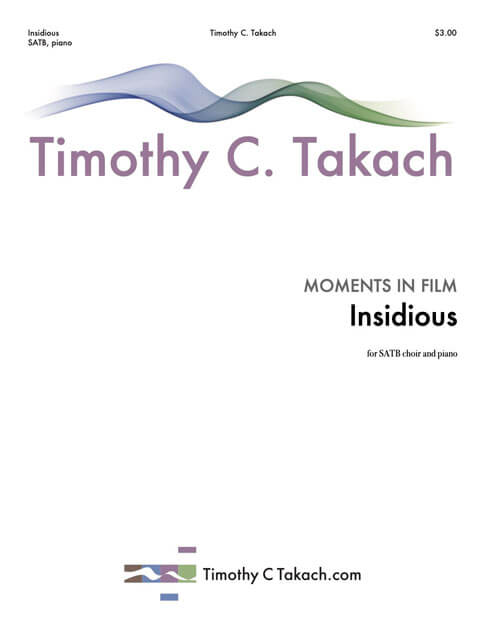
Insidious
Horror choral music: terrifying text, whispering singers and a haunting piano line to portray obsession and possession.
-
A Mural of Change
-
Flying Solo
SATB, piano
from the collection MOMENTS IN FILM
One of the spookiest choral pieces you’ll ever hear, “Insidious” uses a mixture of terrifying text, whispering singers and a haunting piano line to portray obsession and possession. Strange harmonies are made more accessible with thoughtful voice leading, and the piano is semi-supportive throughout, giving moments of help and doubling, but maintaining it’s own independence as well. Special stage effects can make this piece come alive with a darkened house, blacklights, and cell phone flashlights. “Insidious” is followed nicely with Gyorgy Orban’s “Daemon Irrepit Callidus,” both in theme and in relating keys!
Composer’s Notes
As I’ve become more in touch with what drives my creative energy, I’ve tried to find ways to combine my passions together. When I was a kid, this meant putting every topping imaginable on my ice cream. More recently it means making choral music out of new poetry inspired by film.
I have a love of horror movies, so I knew that the Moments in Film project needed to contain something from a horror movie. I asked my poet friend and horror movie lover William Reichard to help out with
a poem. “Insidious” is easily the creepiest song I’ve ever written. And to be truthful, the first poem Bill wrote was so terrifying I couldn’t even consider using it. So I had to send him back to try again (Sorry, Bill!). But this still makes me cringe in all the right ways, so I knew he nailed it.
The 2010 movie “Insidious” is where you should start watching the series, but this poem is inspired by the second installment, 2013’s “Insidious: Chapter 2.” The themes are the same – a little demonic possession, a little soul stealing, a journey into another realm. Right from the beginning, I’m playing with the sound of the choir as some are whispering and some are speaking. As the music progresses we hear the piano growing in richness and range as the possession becomes stronger. The piano writing is pretty off from the beginning, but it gets more aggressive and confident as the piece moves forward. There is no happy ending here.
A broader way of looking at this, though, is through a metaphorical lens. We’ve all seen people become inhabited by other negative forces that can lead to a path of destruction and sometimes death: addiction, rage, racism, etc. With this view, the “He” in the poem is an idea, a sickness. This could be an access point for those who are uncomfortable with the subject matter.
I knew going in that this piece will struggle to find its way onto the stage very often. But darn it, there should be more horror choral music. And now there is. (Pats self on back.)
– Timothy C. Takach, 2018
Text
A piano plays
in an empty room.
A baby cries
in the nursery.
When I look in the mirror
it’s him I see.
He wants the life
that’s meant for me.
My teeth are brittle.
My body decays.
I feel myself
fading away
as he grows stronger.
The dead are greedy.
They try to grasp
any living soul
whenever they can.
They take our place
and we take theirs
in the netherworld
of old nightmares,
in the crumbling house,
in the pitch black Further.
Their sheet-covered bodies
fill a church of the dead.
A congregation full of dread
and he is their minister.
He’s the bride
who’ll wed the sin.
His dead soul is killing
my living skin.
– William Reichard
– Commissioned for this piece. Used with permission.
$1.60 per licensed PDF



Reviews
There are no reviews yet.